

You’ve studied the sign, learned the behaviors, and adapted to the daily rut movements. Time to lace up and hit the ground running.
The rut isn’t a guessing game – it rewards patience, knowledge, and commitment with glory.
Successful hunters have a playbook – a handful of timeless plays that work year after year. Plays that turn chaos into opportunity. Learn. Adapt. Overcome.
Today, I’m breaking down four plays that form the foundation of every rut strategy. Learn them, tweak them to your terrain, and success will follow.
Grab your map, sharpen your pencil, and let’s scratch out your next victory.
PLAY 1: The All-Day Hammer – Rut Funnels
If the rut were football, this play would be the Power-I formation – no fancy motion, just run it straight down the middle and break the defense.
A funnel is any terrain feature that restricts deer movement to a tight corridor. Think creek crossings, saddles, steep draws, pinch points, and plenty more. A rut funnel is simply a funnel that connects two or more doe bedding areas — where bucks naturally cruise between them during peak movement.
GPS-collar studies from Pennsylvania and Wisconsin have confirmed that mature bucks will use multiple bedding areas during the rut – sometimes covering miles between them. When the wind and thermals are right, this is your grind-it-out play. Pack a lunch, settle in, and let the traffic come to you.

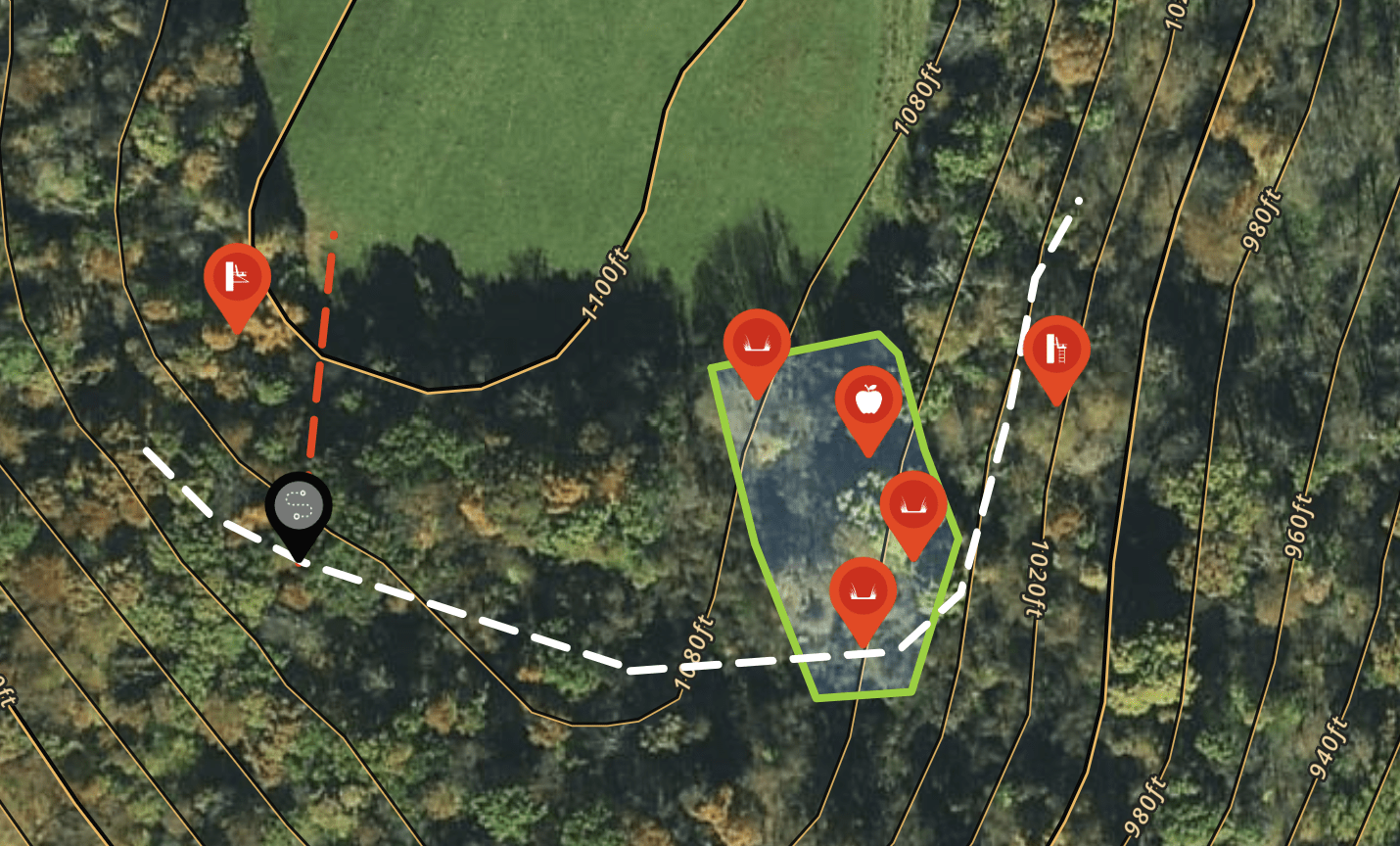
Figure 1 is an overlooked funnel — a place that doesn’t show up on maps until you start looking at slope grading. This pinch point takes advantage of subtle terrain. Deer use the upper third of the hillside to cross between areas — the path of least resistance. Like us, they’ll take the easier route, making the top edge a killer setup for bucks slipping between doe bedding areas.
2nd down and 5. Here comes play 2.
PLAY 2: The Morning Strike – Parallel Trails
Morning hunts aren’t built for the weak. They demand early alarms, long walks through darkness, and even longer sits in the cold. You’ve got to slip through the timber like a ghost – no noise, no mistakes.
The rut play here is catching movement on parallel trails.
Does exit feeding areas around first light, heading back toward bedding cover. Bucks — especially mature ones — travel perpendicular to those doe trails, following what we call parallel trails. These routes let them scent-check every doe heading to bed without being seen.

Notice how the parallel trail cuts multiple travel routes in one stretch — that’s efficiency in motion, and exactly why big bucks love them.
This play can be very hit or miss. The action will be slow, but the payoff can be huge. Don’t think of it as a make-or-break – think of it like taking a deep shot while the downs are in your favor.
In Figure 2, you see a classic parallel trail. When you find one, start by identifying good access points. Find the best possible access, then find your spot. You’re not just worried about where to hunt — you’re worried about how to get there.
In the above example, ideal access comes from the top, straight down through the woods, staying out of the fields where does are likely still feeding.
Remember this: the best access is better than the best spot.
3rd and 5. Let’s dial up play 3.
PLAY 3: The Midday Trap – Doe Bedding
There’s a reason this tactic never goes out of style — during the rut, does are the axis the entire woods spins around. As simple as they come — get downwind of doe bedding cover and wait. It’s the staple of rut hunting. Find the does, and the bucks will follow.
For this to work, you need to know where the doe bedding is. This is where your in-season scouting pays off. Don’t be afraid of bumping a few does before the rut — keeping tabs on where they bed gives you the intel you need to strike when it matters most.
Hunters worry too much about bumping deer. Unless they associate you with danger, they’re not leaving town. In fact, if deer escape unscathed, it only reinforces their confidence in that bedding area. Don’t overdo it though — repeated bumping will push them away.
Doe bedding intel becomes your mid-rut gold mine. Once you’ve marked a few bedding areas, set up ambush spots on the downwind sides for your midday plays. Wait for the day’s thermals and winds to stabilize — then it’s time.
Midday is when mature bucks slip through, checking bedding areas for a hot doe. They know every doe is bedded down, and this is their most efficient window to find one. When that wind steadies and the thermals rise, settle in on the downwind side. Every gust carries their scent to cruising bucks — and maybe, your tag.
4th and 1. The game’s on the line. Time to close this thing out with a victory.
PLAY 4: The Evening Gamble – Staging Areas
Every playbook needs a gamble — the call you make when you’ve studied the field, felt the pressure, and decided to swing for the end zone. This is that play.
Staging areas are built for the grinders — the hunters working heavy-pressured ground, where there seem to be more hunters per square mile than deer. The places where deer sightings are a status symbol and punched tags are the stuff of legend.
A staging area is that in-between zone — nasty, tangled cover where bucks hunker down before stepping into the open. They linger along the edges, watching and waiting. They know the pressure is thick, so they hold tight until it’s safe. These spots aren’t found on maps — they’re earned through miles of boot leather. You’ll know when you’ve found one: it’s the spot you’d rather walk a mile around than push through.
For this play to work, your staging area needs to fall between bedding and food — no exceptions. Set up on the downwind edge like Play 3. As evening thermals drop and does begin filtering toward feed, bucks will move to cut them off or scent-check the line. That’s your moment — stay patient, stay quiet, and be ready when the woods finally explode.
Touchdown. Drive complete. The Rut Playbook is yours.
These plays are only as good as your ability to adapt them to your ground. Paper maps and GPS pins don’t kill deer — execution does.
Mark them. Test them. Tweak them. That’s how you turn theory into venison.
You’ve got the knowledge. You’ve got the plays. Now it comes down to one thing — how you execute.
That choice determines whether you’re dragging a buck out this fall… or telling yourself maybe next year will be your year.
The rut doesn’t wait. Neither should you. Get after it.
Leave a Reply