What exactly are thermals, and how can you use them to improve your hunting? Thermals are air currents created by the heating and cooling of air. Let’s take a step back to one of your first science lessons: hot air rises, and cool air sinks. That’s it. When the sun rises and heats the valley floor, the warm air moves uphill, creating an upward thermal current. Conversely, as the sun sets and the air cools, the thermals reverse direction, flowing back down the hill. Understanding this simple concept can dramatically impact your hunting strategy.
I think of it like this: in the morning, when sunlight begins to warm the area around me or below me on a hill, the thermals will start to flow uphill. In the afternoon, as the sun dips below the horizon and the air cools, the thermals will flow downhill. However, weather conditions and terrain can significantly influence these thermal patterns.
In hilly terrain, thermal effects are much more pronounced than in flat areas. Days with a larger disparity between high and low temperatures will amplify thermal activity. For example, sunny, clear days increase the thermal effect, while cloudy or overcast days reduce it. Wind speed is another critical factor. When wind speeds exceed 10 mph, the prevailing wind direction will often override thermal effects.
Thermals can also shift due to terrain features like ravines, ridges, and vegetation, as well as weather changes. To better understand thermals in your hunting area, study them in the field. A great tool for this is milkweed—drop it throughout your sit and observe how it moves. This hands-on observation will teach you more than any article or diagram can.
Using Thermals to Become a Better Hunter
To make the most of thermals, you need to think like a deer. Deer instinctively use thermals to their advantage. For example, in the morning, bucks often stay near the tops of hills after the thermal reversal to scent-check everything below without descending. In the evening, when heading to a field, they may use a low spot to scent-check the area before entering.
Here are a few illustrated scenarios to help clarify:
Scenario 1: Rut Hunt in Hill Country
In this example, the red areas indicate bedding zones, the purple marks represent tree stand locations, and the white arrows show the likely travel paths of bucks. Bucks often travel along ridge tops between bedding areas to scent-check for does.
This scenario assumes minimal wind or a steady southwest wind. I prefer this ambush spot because it allows me to intercept bucks without setting up too close to doe bedding areas, where the increased number of eyes and ears makes it easier to get busted.

Scenario 2: Late-Season Gun Setup
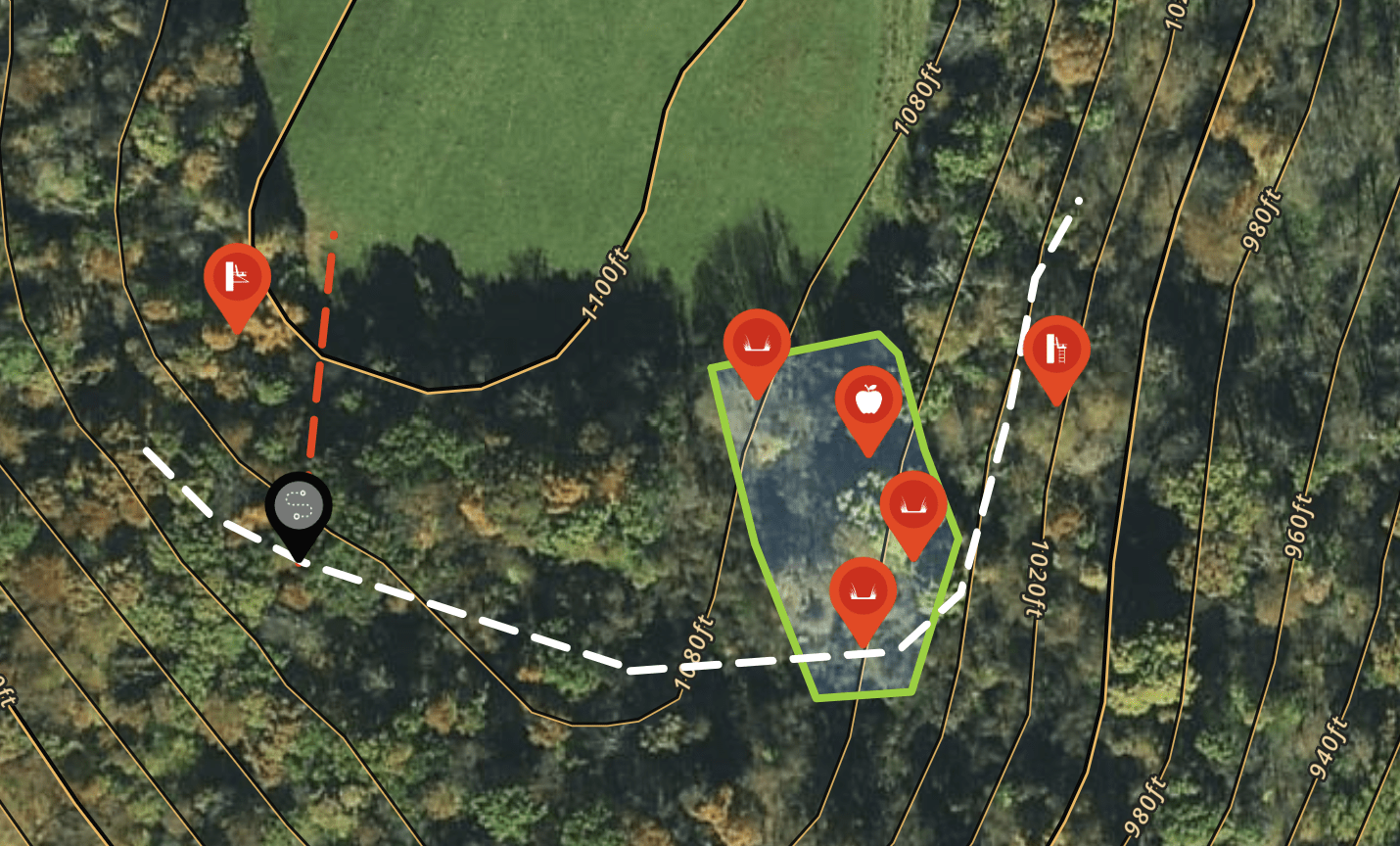
For late-season gun hunting, the green box represents a food source, the purple mark is your stand or blind, and the white arrow is the buck’s travel route.
In this setup, positioning yourself so that your scent drifts down the hill behind you is crucial. This setup works best with a westerly wind but becomes tricky with a northerly wind, as scent control becomes harder to manage.
This location works well because bucks can scent-check the field from the ravine opposite your stand. Your stand placement also uses the drop-off behind it to carry your scent down and away from the deer.

Scenario 3: Thermal Hub
A thermal hub is a feature where several ravines converge, creating a hotspot for deer activity. These hubs allow deer to scent-check multiple areas simultaneously.
In the diagram, red lines indicate thermal currents, white lines show ridges being scent-checked from the hub, and black marks represent your trail camera or stand location.
While thermal hubs can be fantastic spots for hunting or collecting trail camera inventory, they are tricky to hunt. The combination of thermals and prevailing winds can cause your scent to swirl unpredictably, so use caution when hunting these areas.

Final Thoughts
Understanding and using thermals can elevate your hunting game. Start by studying thermals in your area with milkweed—it’s an invaluable tool that shows how your scent carries through the woods.
If you remember just one thing, it should be this: thermals go up when it’s getting warmer and down when it’s getting cooler. Learn to harness this natural movement, and you’ll become a more strategic and successful hunter.