

Don’t guess—test. Soil testing for deer food plots is the difference between lush, high-nutrition forage and plots that flop. Here’s how to collect, read, and apply your results so you know exactly how much lime and the best fertilizer for deer food plots to use.
Why Soil Testing Matters Before You Plant
This is the part where the teacher tells you to go home and study for the test—and it’s easy to blow off when no one’s watching. But here’s the truth: soil testing is what separates food plots that thrive from those that flop.
Skipping your soil sample is like shooting in the dark. Without it, you’re guessing what your soil needs—and that guesswork can leave plants stunted and your forage less nutritious for the deer you’re trying to attract. Since we’ve already picked seed and designed a layout that maximizes hunting potential, it’s time to dial in the foundation—your soil.
How to Take a Soil Sample for a Deer Food Plot
Grab a soil sample kit (Whitetail Institute works great, as do local co-ops and ag extension offices). The process is simple:
- Take core samples roughly 6 inches deep using a soil probe or spade.
- Collect multiple samples across the plot into a clean 5-gallon bucket.
- Mix the soil thoroughly to get a representative sample.
- Fill your labeled sample bag or container and mail it off.
Interpreting Your Soil Sample Results
When you submit your sample, you’ll select the seed blend you plan to plant. The lab will test your soil and tailor recommendations for that crop. Typical metrics include:
- pH level — measures acidity/alkalinity (most crops prefer 6.0–7.0).
- Nutrient levels (N-P-K) — nitrogen, phosphorus, potassium; plus calcium and magnesium.
- Organic matter — fertility and microbial activity.
- CEC (Cation Exchange Capacity) — how well soil holds nutrients.
Based on these numbers, the report recommends how much lime (to adjust pH) and fertilizer (to boost nutrients) to apply—either per acre or per 1,000 sq ft. As a rule:
- Use pounds per 1,000 sq ft for plots under an acre.
- Use pounds per acre for larger fields.

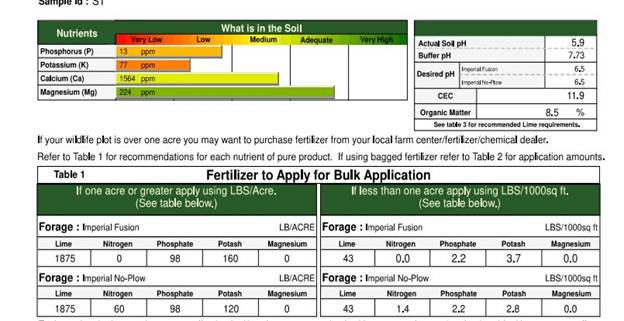
Reading from the top down:
- Phosphorus and potassium are low—both are critical for healthy forage.
- Calcium and magnesium levels look good.
- pH is 5.9 (a little low). The target for this seed blend is 6.5, so lime is needed.
Step 1: Convert Your Plot Size
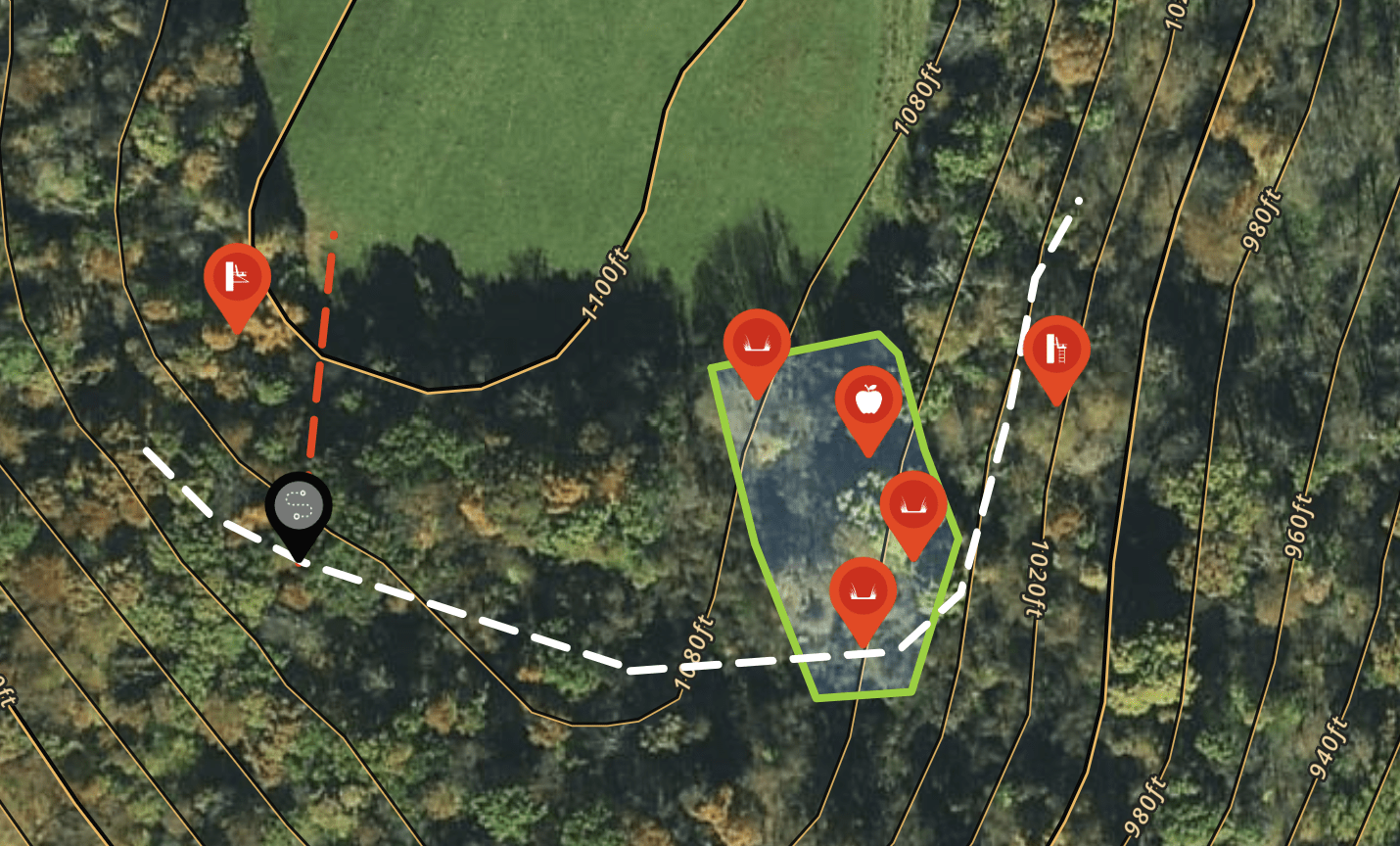
Measure your plot with OnX or a similar tool. Example: 0.35 acres. Convert acres to square feet:
1 acre = 43,560 sq ft
0.35 ac × 43,560 = 15,246 sq ft
Step 2: How Much Lime for a Deer Food Plot (Adjusting pH)
Low pH locks up nutrients—even if you fertilize. Your report might recommend something like 43 lb of lime per 1,000 sq ft. Calculate total lime:
Units of 1,000 sq ft = 15,246 ÷ 1,000 = 15.246
Total lime (baseline) = 43 × 15.246 = 656 lb
Adjust for Pelletized Lime (ECCE)
If the lab assumes ECCE 1,400 lb/ton but your pelletized lime is ECCE 1,768 lb/ton, adjust:
Required ECCE per 1,000 sq ft = 43 × (1400 ÷ 2000) = 30.1
New lime rate per 1,000 sq ft = 30.1 × (2000 ÷ 1768) = 34.05 lb
Total pelletized lime = 34.05 × 15.246 ≈ 519 lb ≈ 13 bags @ 40 lb
Step 3: Best Fertilizer for Deer Food Plots
Fertilizer numbers list N-P-K percentages (e.g., 13-13-13, 0-46-0, 0-0-60). A 50-lb bag of 13-13-13 contains 6.5 lb each of N, P, and K. Your report could provide options such as:
- Option 1: 0-20-20 + 0-0-60
- Option 2: 0-46-0 + 0-0-60 (less total material)
Fertilizer Math (per 1,000 sq ft → total plot)
Example needs (per 1,000 sq ft): 0-46-0 at 4.89 lb and 0-0-60 at 6.12 lb.
Total units = 15.245 (from 15,245 sq ft)
0-46-0 total nutrient = 4.89 × 15.245 ≈ 75 lb
0-0-60 total nutrient = 6.12 × 15.245 ≈ 93 lb

Convert to product weight:
0-46-0 product = 75 ÷ 0.46 ≈ 163 lb  ≈ 4 bags @ 50 lb
0-0-60 product = 93 ÷ 0.60 ≈ 155 lb  ≈ 4 bags @ 50 lb

Common Mistakes Hunters Make
- Skipping the soil test to “save time.”
- Using ag-lime without checking ECCE.
- Ignoring low phosphorus (P)—a common growth limiter.
- Applying high-nitrogen blends on clover (burn risk and weed pressure).
Quick Reference: Food Plot Soil Cheat Sheet
| Crop Type | Ideal pH | Key Nutrients | Example Fertilizer |
|---|---|---|---|
| Clover | 6.5–7.0 | P, K | 0-20-20 |
| Brassicas | 6.0–6.8 | N, K | 13-13-13 |
| Soybeans | 6.2–6.8 | P, K | 0-46-0 + 0-0-60 |
| Cereal Grains | 6.0–7.0 | N | 19-19-19 |
Pro Tip: Keep a Soil Log
Track pH, lime and fertilizer rates, crop type, and yield each season. Over time, you’ll fine-tune inputs and maximize plot performance.
Key Takeaways
- Soil testing for deer food plots removes guesswork.
- Lime fixes low pH and unlocks nutrients.
- Fertilizer builds dense, attractive forage.
- Track results yearly to improve consistency.

Leave a Reply